

Recourse to Interference with Child Custody
In the State of Texas, interference with child custody is punishable both civilly and criminally.
According to the Texas Family Code, a person who takes, retains, or conceals the whereabouts of a child at a time when another person is entitled to possession or access of the child may be liable for civil damages to that person.
The damages that may be recovered are expenses incurred while locating the child, securing the possession of the child, and enforcing the order, including attorneys fees. One may also be entitled to mental suffering and anguish incurred due to the interference and violation of the order. One may also be entitled to exemplary (punitive) damages if the violating party acts with malice, or an intent to harm the other party.
A violator can also be held criminally liable for interfering with child custody. According to the Texas Penal Code, a person commits an offense if they take or retain a child younger than 18 years of age, and:
- The person knows their taking or retention violates the express terms of a judgment or order, including a temporary order, of a court disposing of the child’s custody; or
- when the person has not been awarded custody of the child by a court of competent jurisdiction, knows that a suit for divorce or a civil suit or application for habeas corpus to dispose of the child’s custody has been filed, and takes the child out of the geographic area of the counties composing the judicial district if the court is a district court or the county if the court is a statutory county court, without the permission of the court and with the intent to deprive the court of authority over the child; or
- outside of the United States with the intent to deprive a person entitled to possession of or access to the child of that possession or access and without the permission of that person.
A noncustodial parent commits an offense if, with the intent to interfere with the lawful custody of a child younger than 18 years, the noncustodial parent knowingly entices or persuades the child to leave the custody of the custodial parent, guardian, or person standing in the stead of the custodial parent or guardian of the child. Such an offense is a state jail felony which, if prosecuted, can lead to fines of up to $10,000.00 and anywhere from 180 days to two years in state jail.
Nacol Law Firm P.C. – Fathers Rights Attorneys – Dallas TX
Disclaimer: The information provided in this article is in no way intended to constitute legal advice. The information provided is merely an overview of the relevant law. Do not act on this information. Always consult an attorney for legal advice.

Divorcing a Narcissist
What is a narcissist? Narcissistic Personality Disorder or ‘NPD” is a mental disorder where the person has very inflated self-esteem issue and a serious need for admiration and special treatment from other people. Typical arrogant behavior and lack of empathy for other people causes many problems in all emotional areas of their lives and relationships.
Narcissists are also very aggressive and usually have impulsive tendencies, dangerous lifestyles involving cockiness, selfishness, manipulation and power motives. These individuals are usually very exciting personalities at first meeting, but later cause unfulfilling relationships resulting in anxiety and depression at the end of the day.
You have met the “most exciting” person in the world who has self-esteem problems and can’t get along with anyone, including you! The big problem is that you married this person and now you MUST FIND A SOLUTION TO THIS SITUATION AND GET A DIVORCE!
The marriage adventure is over. Your married life to your narcissist was a total disaster and you know that you need to get a divorce. Are you frightened that you could very well lose everything in this divorce from hell since you may lack the manipulating skills that your narcissist spouse skillfully uses on all aspects of his/her manipulative lifestyle?
Before you start the Divorce battle with your narcissist, you must “Stop Feeling and Start Thinking”! You have been emotionally battered and mutilated for years by this spouse, but now is the time to take over your life and your children’s lives and decide that Your family DOES NOT AND WILL NOT TAKE THIS ABUSE ANYMORE FROM YOUR SPOUSE!
Here are some tips on planning your exit from this marriage and Win control of your life and your family lives.
- BE PREPARED! If you are thinking of going through with this divorce, start your preparations now! You need total knowledge of your family’s financial situation. On our website you can pull off a blog “Texas Divorce Financial Checklist” (http://www.divorcedallastx.com/texas-divorce-financial-checklist/) which will give you a guideline on your financial information needed. Update this information immediately. Know who makes what and where all monies and assets are located. All banking and account information should be update for correct account numbers and balances. This will help you determine how much money you will need to live on and what you can plan on your part of the assets. This will also give you an idea on what funds you can use to hire a competent attorney to help you get through the divorce.
- RESEARCH PRIORITY ISSUES! Educate yourself on divorce issues, such as child custody and visitation, who gets the house, property separation, spousal maintenance and child support in your state. Prioritize what is important to you and prepare questions to ask an attorney on what your expectations should be. All or nothing does not work. Set Reasonable goals.
- START INTERVIEWING ATTORNEYS to find a good match to help you through this complicated divorce. Look for an attorney who deals with difficult family law cases concerning emotional/domestic abuse, high conflict individuals, or contested child custody. Even if you are served divorce papers, take your time finding an experienced attorney who will be your advocate in the divorce. DO NOT HIRE A NARCISSIST ATTORNEY! This would be a disaster!
- Help Plan your Divorce Game plan! No one knows your Narcissist spouse or family situation better than you. What arguments/facts will they come up with to hurt your position? Discuss your entire situation with you attorney and work together on your divorce approach. Your attorney will help you determine your final goals through experience from his previous experience in such matters.
- STAY REASONABLE AND TRY TO KEEP EMOTIONS STEADY! Don’t let your narcissist spouse turn you into a narcissist! You cannot win this way! Think logical, use true facts, and don’t go overboard financially battling with him/her. If this gets settled, goes to mediation, or ever a jury trial, it will be over and you will greatly improve your life.
You married a Narcissist and now you are divorcing him/her. You must be prepared knowing that your spouse will now be able to participate in the greatest show of their lives, “THE DIVORCE”. Your spouse will try to show what a horrible, ungrateful, unworthy person/parent you are and how badly you hurt your innocent victim/martyr spouse.
Irrelevant are your feelings and emotions. By thinking and planning your divorce strategy with a qualified attorney you will be prepared for battle and to live your life as you choose.
Remember the focal point of his/her narcissistic behavior is the fear of abandonment and threat to his/her self-worth. Be well-prepared for the battle ahead. The key is to not respond emotionally and let it drain you. Observe their behavior as a disorder, and don’t absorb it as a literal or personal attack on you.
If you mitigate for his/her drawn-out narcissistic rage and know that he/she may attempt to destroy you, you will less likely feel bullied or defeated. Be forewarned, you will be less victimized by something you expect.

Modification of Child Custody or Visitation Rights for Texas Fathers
Texas family law states that a court may modify a child custody order if the change is in the best interest of the child and one of the following applies:
1. The circumstances of the child or parent have materially or substantially changed since the date of the original child custody order or order to be modified.
2. The child is at least 12 years of age and will tell the court in private chambers with the judge that he/she would like a change.
3. The custodial parent has voluntarily given the child’s care and custody to another person for at least 6 months.
Material or Substantial Change
What could be acceptable as a change for the Texas family courts? Some examples could be a parent’s remarriage, a medical condition the affects a parent’s ability take care of the child, a parent’s criminal acts or convictions, a parent’s change in residence that makes visitation a hardship for the other parent, family violence, drug or alcohol related issues, absence of supervision, and other material changes concerning adequate care and supervision of the child.
Child Wants Change
The child must be at least 12years of age and maybe interviewed in the judge’s chambers. The court will consider the child’s desire but only make a change if it is in the child’s best interest.
Custody Relinquishment
This happens when the custodial parent has voluntarily given up custody of the child to another person for at least six months. This does not apply to a period of military deployment or duty.
After finding one of the three prerequisites, the court must still consider whether the change will be in the child’s best interest. The court will consider factors affecting the child’s physical, emotional, mental, education, social, moral or disciplinary welfare and development. The factors considered for this evaluation are:
1. Child’s emotional and physical needs.
2. Parenting ability of the conservators or potential conservators
3. Plans and outside resources available to persons seeking the modification
4. Value to the child of having a relationship with both parents
5. Visitation schedule that requires excessive traveling or prevents the child from engaging in school or social activities
6. Stability of the person’s home seeking the modification
7. The child’s desires
8. Child’s need for stability and need to limit additional litigation in child custody cases.
Modification within one year of prior court order
A parent who files a motion to modify a child custody order within one year after a prior order was entered must also submit an affidavit to the court. The affidavit must contain, along with supporting facts, at least one of the following allegations:
1. The child’s present environment may be endanger the child’s physical health or significantly impair the child’s emotional development.
2. The person who has the exclusive right to designate the child’s primacy residence is the person seeking or consenting to the modification and the modification is in the child’s best interest.
3. The person who has the exclusive right to designate the child’s primary residence has voluntarily relinquished the primacy care and possession of the child for at least six months and the modification is in the child’s best interest.

Unique Possession Orders that Work with a Fathers Profession
Many professions create impositions on conservators making a standard possession order inapplicable and unworkable. The Court may deviate from a standard possession order if the order is inappropriate or unworkable in reference to the schedules of both the conservators and the child. Unique professions and irregular school schedules for children allow the Court to have flexibility to deviate from a standard possession order that is in the Best Interest of the Child. There are multiple ways in which the Court may depart from a standard possession order to fulfill the needs of all parties involved with the custody of the child.
First, the Family Code § 153.254 states that the Court will be allowed deference to modify the standard possession order if work schedules of either conservators or the school schedule of the child is irregular. The Court must attempt to narrowly tailor the modifications to keep the new possession order as similar to the standard possession order as possible. This instance most commonly occurs when the Managing Conservator and the Possessory Conservator cannot reach an agreement and one of the two Conservators has a unique profession such as a firefighter, police officer, or airline pilot. The working hours of these jobs allow the Court to modify the standard possession order even if both of the parties do not comply with the changes. The modifications must be made only if it is in the Best Interest of the Child.
Secondly, the standard possession order may always be modified if it is by the mutual agreement of both the Managing Conservator and Possessory Conservator. Family Code § 153.007 is the Agreed Parenting Plan Statute and allows for both parties to agree on a standard possession order for the child. This statute was passed to promote amicability in settlement for child custody issues and to give flexibility to the parents if they are willing to agree on custody terms. The Agreed Parenting Plan must be in the Best Interest of the Child for the Court to approve. If the Court grants the Agreed Parenting Plan then the Managing or Possessory Conservator will have a remedy as a matter of law for any violation of the agreement committed by either party.
Finally, both Conservators may enter into a Mediated Settlement Agreement under Family Code § 153.0071. A Mediated Settlement Agreement is the only time in which the Court will NOT look at the Best Interest of the Child when granting the custody agreement.
The Mediated Settlement Agreement § 153.0071 must be:
- In bold, underlined, and capital letters that the agreement is NOT REVOCABLE
- Signed by Both Parties to the agreement
- Signed by the lawyers (if represented) of each party
The Mediated Settlement Agreement is binding and not revocable so if the Conservators wish to go this route they must understand that what is in the agreement will be held as binding. This method can be used to modify or change a standard possession order and the Court will not look at the Best Interest of the Child regarding the agreement, unless there exists a credible threat of domestic violence.
These are the methods in which a unique possession order may be obtained to accommodate irregular schedules or working hours of both the conservators. Any possession order must be correctly drafted and all future contingencies must be accounted for. An experienced lawyer must be contacted to safeguard an individual’s custody rights of their children and to make sure that a fair custody arrangement is obtained.

How Much is Texas Child Support? Texas Child Support Guidelines
UPDATE ON TEXAS CHILD SUPPORT, EFFECTIVE SEPTEMBER 1, 2025:
A new cap is effective for all child support orders finalized on or after September 1, 2025
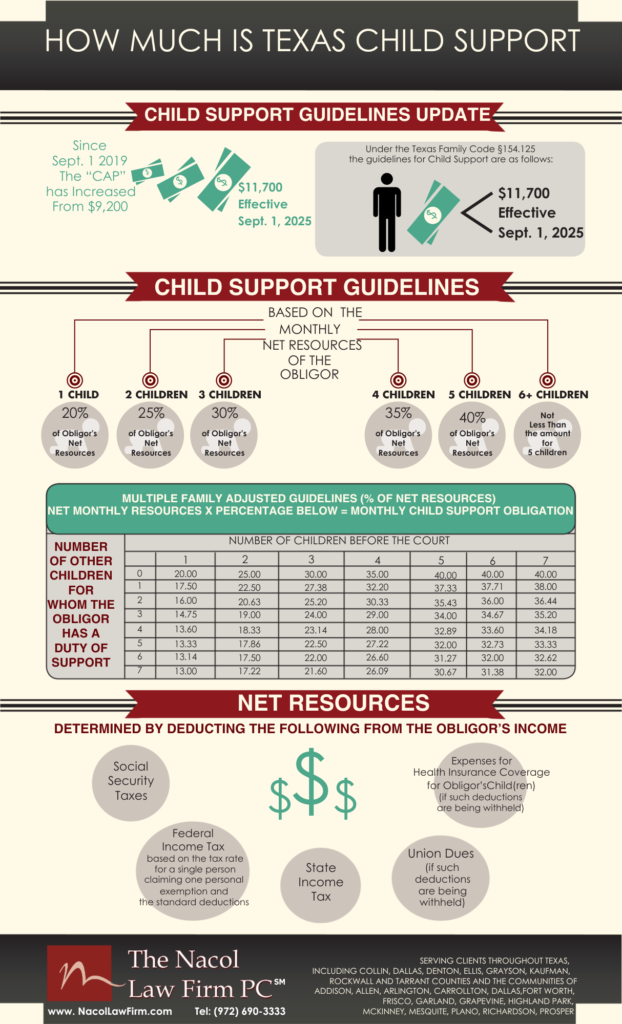
The Texas child support cap increased from $9,200 to $11,700 in net monthly resources for orders finalized on or after September 1, 2025, following legislative changes to the Family Code. This significant adjustment, part of the regular Texas child support guideline review, means higher guideline support amounts for higher-income parents. For example, the new cap results in a maximum monthly payment of $2,340 for one child (20% of $11,700) and up to $4,680 for five or more children (40% of $11,700) under the standard guideline framework.
Texas Family Code §154.125(a)(1) requires that every six years the presumptive amount of net resources to which the child support guidelines apply shall be reviewed and adjusted for inflation by the Texas Office of the Texas Attorney General (OAG). That section sets out the formula for doing so based on the consumer price index. The last adjustment was done in 2019 when an amount of $9200 per month was established.
How does the “cap” work and what could this mean for you? If your net monthly resources are less than $11,700, the child support obligation will not change on Sept. 1. You are under the “current cap” and lower than the “new cap”. All stays the same.
If you are currently going through litigation and your net monthly resources exceeds $11,700 and the Court orders child support prior to September 1, 2025, Texas Child Support Guidelines will mandate that the Court apply the appropriate child support percentage to the first $9,200 in net monthly resources based on the number of children. But, if the Court orders child support after September 1, 2025, it will apply the new appropriate child support percentage to the first $11,700 in net monthly resources.
Child support under the guidelines is determined by applying the applicable percentage, beginning at 20% for one child and increasing incrementally for each additional child, to the net resources amount. If a child support obligor has monthly net resources over $11,700, a party seeking above the guideline’s child support has the burden of proving to the court that additional support should be ordered according to factors set out in Texas Family Code §154.126.
Important to Know: The new “cap” increase of September 1, 2025 will not automatically increase the obligor’s existing child support obligation. Any change in child support standing before September 1, 2025, can only occur through the court with a modification order to increase the child support to the new “Cap” amount of $11,700. After September 1, 2025, any new suit for child support will be subject to the new “cap”.
Please review the Texas Office of the Texas Attorney General (OAG) website for a child support calculator for the new breakdown: https://csapps.oag.texas.gov/monthly-child-support-calculator
The Nacol Law Firm PC
8144 Walnut Hill Lane
Suite #1190
Dallas, Texas 75231
Nacollawfirm.com
NACOL LAW FIRM P.C.
8144 Walnut Hill Lane
Suite 1190
Dallas, Texas 75231
972-690-3333
Office Hours
Monday – Thursday, 8am – 5pm
Friday, 8:30am – 5pm
OUR BLOGS

SEARCH
JOIN OUR NETWORK

Attorney Mark A. Nacol is board certified in Civil Trial Law by the Texas Board of Legal Specialization