


Preventing Out of State Relocation of Children by Custodial Parent
Mom and Dad are divorcing or have been divorced and are now sharing joint custody of their children in the same city in Texas. One parent receives a letter from the other parent’s attorney requesting that this parent be allowed to relocate the children to another state so he/she may take a better job position with another company! This is a dilemma no parent ever wants to experience! Child Custody cases involving interstate relocation jurisdiction issues cause much heartache and are costly legal battles.
What can a Parent do to protect themselves from children being relocated away from the non-moving parent to another state without her/his consent? How may this affect the parent’s relationship with the children?
The Texas Family Code 153.002 Best Interest of Child states “The best interest of the child shall always be the primary consideration of the court in determining the primary consideration of the court in determining the issues of conservatorship and possession of and access to the child.”
The Texas Family code does not elaborate on the specific requirement for modification in the residency-restriction context, and there are no specific statutes governing residency restrictions or their removal for purposes of relocation. Texas Courts have no statutory standards to apply to this context.
The Texas Legislature has provided Texas Family Code 153.001, a basic framework on their public policy for all suits affecting the parent-child relationship:
-
The public policy of this state is to:
-
Assure the children will have frequent and continuing contact with parents who have shown the ability to act in the best interest of the child;
-
Provide a safe, stable, and nonviolent environment for the child;
-
Encourage parents to share in the rights and duties of raising their child after the parents have separated or dissolved their marriage.
How does The State of Texas treat an initial Child Custody determination?
Texas Family Code 152.201 of the UCCJEA states, among other things, that a court may rule on custody issues if the Child:
- Has continually lived in that state for 6 months or longer and Texas was the home state of the child within six months before the commencement of the legal proceeding.
- Was living in the state before being wrongfully abducted elsewhere by a parent seeking custody in another state. One parent continues to live in Texas.
- Has an established relationship with people (family, relatives or teachers), ties, and attachments in the state
- Has been abandoned in an emergency: or is safe in the current state, but could be in danger of neglect or abuse in the home state
Relocation is a child custody situation which will turn on the individual facts of the specific case, so that each case is tried on its own merits.
Most child custody relocation cases tried in Texas follow a predictable course:
-
Allowing or not allowing the move.
-
Order of psychological evaluations or social studies of family members
-
Modification of custody and adjusting of child’s time spent with parents
-
Adjusting child support
-
Order of mediation to settle dispute
-
Allocating transportation costs
-
Order opposing parties to provide all information on child’s addresses and telephone #
Help to Prevent Your Child’s Relocation in a Texas Court by Preparing Your Case!
-
Does the intended relocation interfere with the visitation rights of the non- moving parent?
-
The effect on visitation and communication with the non-moving parent to maintain a full and continuous relationship with the child
-
How will this move affect extended family relationships living in the child’s current location?
-
Are there bad faith motives evident in the relocating parent?
-
Can the non-moving parent relocate to be close to the child? If not, what type of separation hardship would the child have?
-
The relocating parent’s desire to accommodate a new job, spouse, or other criteria above the parent-child relationship. A Parent’s personal desire for move rather than need to move?
-
Is there a significant degree of economic, emotional or education enhancement for the relocating parent and child in this move?
-
Any violation of an order or prior notice of the intended move or a temporary restraining order
-
Are Special Needs/ Talents accommodated for the child in this move?
-
Fear of child and high cost of travel expenses for non-moving parent or child to visit each other to be able to continue parent- child relationship.
-
What other Paramount Concerns would affect the child concerning the relocation from the non-moving parent?
At the Nacol Law Firm PC, we represent many parents trying to prevent their child from relocating to another city or state and having to experience “A Long Distance Parental Relationship” brought on by a better job or new life experience of the relocating parent! We work at persuading courts to apply the specific, narrow exceptions to these general rules in order to have child custody cases heard in the most convenient forum in which the most qualifying, honest evidence is available; cases where the child’s home state or other basic questions are clarified, and cases where a parent has the right in close proximity with their child regardless of other less important factors.



How Much is Texas Child Support? Texas Child Support Guidelines
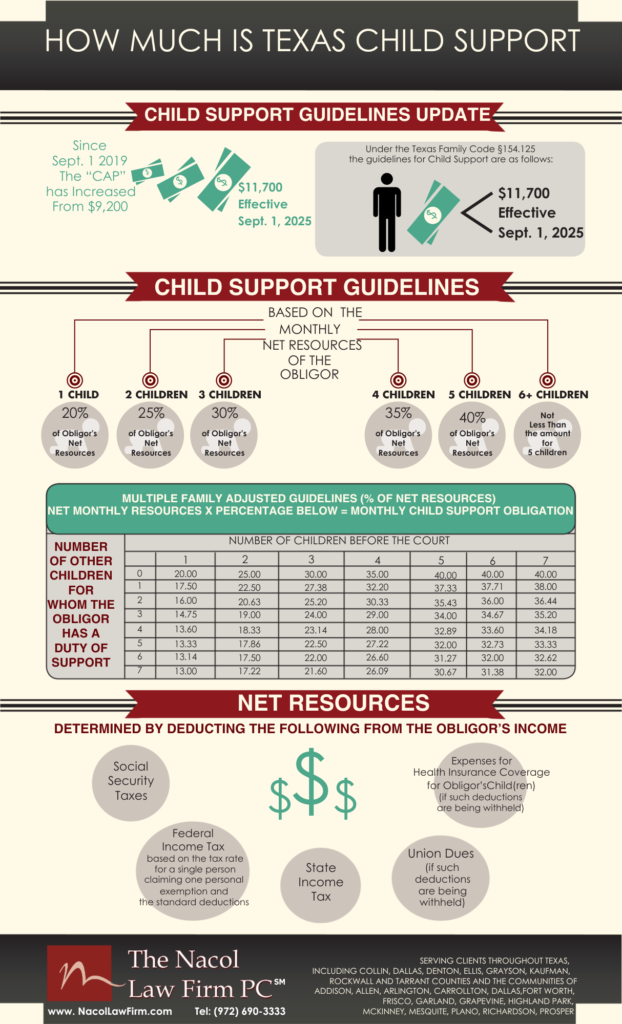
UPDATE ON TEXAS CHILD SUPPORT, EFFECTIVE SEPTEMBER 1, 2025:
A new cap is effective for all child support orders finalized on or after September 1, 2025
The Texas child support cap increased from $9,200 to $11,700 in net monthly resources for orders finalized on or after September 1, 2025, following legislative changes to the Family Code. This significant adjustment, part of the regular Texas child support guideline review, means higher guideline support amounts for higher-income parents. For example, the new cap results in a maximum monthly payment of $2,340 for one child (20% of $11,700) and up to $4,680 for five or more children (40% of $11,700) under the standard guideline framework.
Texas Family Code §154.125(a)(1) requires that every six years the presumptive amount of net resources to which the child support guidelines apply shall be reviewed and adjusted for inflation by the Texas Office of the Texas Attorney General (OAG). That section sets out the formula for doing so based on the consumer price index. The last adjustment was done in 2019 when an amount of $9200 per month was established.
How does the “cap” work and what could this mean for you? If your net monthly resources are less than $11,700, the child support obligation will not change on Sept. 1. You are under the “current cap” and lower than the “new cap”. All stays the same.
If you are currently going through litigation and your net monthly resources exceeds $11,700 and the Court orders child support prior to September 1, 2025, Texas Child Support Guidelines will mandate that the Court apply the appropriate child support percentage to the first $9,200 in net monthly resources based on the number of children. But, if the Court orders child support after September 1, 2025, it will apply the new appropriate child support percentage to the first $11,700 in net monthly resources.
Child support under the guidelines is determined by applying the applicable percentage, beginning at 20% for one child and increasing incrementally for each additional child, to the net resources amount. If a child support obligor has monthly net resources over $11,700, a party seeking above the guideline’s child support has the burden of proving to the court that additional support should be ordered according to factors set out in Texas Family Code §154.126.
Important to Know: The new “cap” increase of September 1, 2025 will not automatically increase the obligor’s existing child support obligation. Any change in child support standing before September 1, 2025, can only occur through the court with a modification order to increase the child support to the new “Cap” amount of $11,700. After September 1, 2025, any new suit for child support will be subject to the new “cap”.
Please review the Texas Office of the Texas Attorney General (OAG) website for a child support calculator for the new breakdown: https://csapps.oag.texas.gov/monthly-child-support-calculator
The Nacol Law Firm PC
8144 Walnut Hill Lane
Suite #1190
Dallas, Texas 75231
Nacollawfirm.com
NACOL LAW FIRM P.C.
8144 Walnut Hill Lane
Suite 1190
Dallas, Texas 75231
972-690-3333
Office Hours
Monday – Thursday, 8am – 5pm
Friday, 8:30am – 5pm
OUR BLOGS

SEARCH
JOIN OUR NETWORK

Attorney Mark A. Nacol is board certified in Civil Trial Law by the Texas Board of Legal Specialization